


How Javad Vasheghani Farahani’s Study Redefines Trust, Transparency, and Energy Efficiency
Cryptocurrencies were born from the dream of decentralization.
Renewable energy was born from the need for sustainability.
Today, these two revolutions are converging — and at the intersection stands Javad Vasheghani Farahani, a visionary researcher who has built one of the first blockchain-based energy systems that is both verifiable and environmentally responsible.
His peer-reviewed paper, “A Sustainability Assessment of a Blockchain-Secured Solar Energy Logger for Edge IoT Environments”, published in MDPI Sustainability (Vol. 17, Issue 17, 8063), delivers the first experimental proof that blockchain can serve climate goals instead of undermining them.
This work does not rely on speculation or tokenomics; it relies on science, measurement, and reproducibility — the foundation of sustainable innovation.
The Context: Blockchain’s Energy Controversy
From Bitcoin’s soaring electricity consumption to Ethereum’s transition to Proof-of-Stake, energy efficiency has been at the heart of blockchain’s credibility problem.
Critics have long argued that crypto networks, while decentralized, are unsustainable — a contradiction in an era of carbon accountability.
But the narrative is shifting.
Recent innovations in green blockchain architectures, Proof-of-Stake, and Layer-2 solutions show that decentralization can coexist with environmental responsibility.
Farahani’s research adds empirical weight to this evolution by designing and testing a micro-scale blockchain system that not only records renewable-energy data but does so with negligible carbon impact.
The Breakthrough: A Blockchain-Secured Solar Logger
At its core, Farahani’s project combines blockchain , IoT (Internet of Things), and edge computing to create a transparent solar-energy recording network.
The Problem
Energy data in distributed solar networks is often unreliable.
Producers, investors, and regulators need trustworthy and tamper-proof data to verify generation, measure carbon savings, and issue renewable-energy certificates (RECs).
The Solution
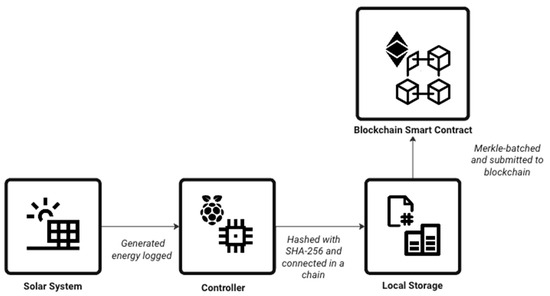
The research introduces a solar energy logger that:
- Collects live data from photovoltaic panels.
- Encrypts each data point using SHA-256.
- Compresses it into a Merkle Tree.
- Uploads the root hash periodically to the Ethereum Sepolia blockchain.
This structure creates a public, immutable ledger of energy production—auditable by anyone, anywhere, without relying on centralized authorities.
Inside the System: Hardware and Design
Unlike cloud-based blockchain applications, this system runs on lightweight hardware designed for real-world sustainability testing.
Hardware Configuration:
- Raspberry Pi 4 (4GB RAM) – central processing unit.
- INA219 sensor – voltage and current measurement.
- TP4056 + 18650 battery – for off-grid power buffering.
- 6V 1W solar panels – energy source for the system.
Software Framework:
- Python-based data acquisition and blockchain interface.
- Cryptographic hashing (SHA-256).
- Merkle Tree aggregation logic.
- Web3.py for Ethereum smart-contract communication.
This configuration achieves high data integrity with extremely low power usage—validating that green blockchain is not a myth but an engineering choice.
Measured Results: Data Over Hype
To prove sustainability, Farahani’s system underwent six full days of testing.
The findings reveal the potential of Proof-of-Concept engineering over simulation-based assumptions common in blockchain whitepapers.
| Metric | Value | Interpretation |
|---|---|---|
| CPU Utilization | 0.01% | Minimal computational load |
| Memory Usage | 100 MB | Lightweight process footprint |
| Max Device Temperature | 43.8°C | Within safe IoT thresholds |
| Power Consumption | 0.00063% of PV Output | Environmentally negligible |
This is the first documented instance of blockchain data logging operating with virtually zero additional energy burden—a milestone for the digital sustainability movement.
National and Global Impact Modeling
To evaluate scalability, the system was modeled across 250,000 photovoltaic units in Austria, matching national energy data from the IEA-PVPS 2022 report.
Even at this scale, total CO₂ emissions were estimated at just 5.2 tons per year, a rounding error in the context of Austria’s renewable energy footprint.
This suggests that blockchain can serve as a carbon-neutral backbone for renewable-energy verification systems worldwide.
Imagine a future where every solar panel, wind turbine, and grid meter speaks the same digital language of truth — verified on-chain, accessible to all.
Implications for Crypto and Forex Markets
The implications of Farahani’s findings extend beyond energy infrastructure — they reshape the economic foundation of the crypto and forex industries.
- Sustainable Tokenization of Energy Assets
- Blockchain-secured data enables tokenization of real-world energy units (kWh, CO₂ credits, RECs).
- These tokens can trade in green crypto markets, backed by verified on-chain data rather than speculation.
- Trust-Driven ESG Investments
- Institutional investors increasingly demand blockchain-based ESG transparency.
- Systems like Farahani’s create trust layers for carbon markets, green bonds, and impact-linked loans.
- Forex and National Currencies
- Central banks exploring CBDCs can use blockchain-verified energy data to back energy-pegged stablecoins, creating a bridge between digital finance and physical sustainability.
This model links crypto value to real renewable productivity, stabilizing markets and aligning them with climate goals.
Methodology: Science Meets Strategy
The research employed a rigorous Design Science Research (DSR) methodology, which integrates engineering with evaluation.
This framework is ideal for transforming conceptual blockchain designs into functional prototypes validated through empirical measurement.
Each stage — from system design to implementation — was supported by data collection, energy auditing, and error verification.
Unlike many theoretical sustainability claims in the crypto space, Farahani’s work provides quantitative evidence of blockchain’s environmental compatibility.
Academic Recognition and Global Context
Farahani’s study positions itself alongside groundbreaking works from MIT, TU Wien, and the University of Cambridge on blockchain sustainability.
However, unlike most academic models, his research includes working hardware, empirical datasets, and public smart-contract validation (Ethereum Sepolia address: 0x611bBD7fDF67F576c77d1520797903A45bcf3377).
This level of transparency aligns with the principles of open science and reproducibility, hallmarks of trustworthy research.
It also provides an educational framework for universities teaching sustainable blockchain systems — bridging academic rigor and industrial relevance.

The Researcher Behind the Innovation
Javad Vasheghani Farahani (Jay Hani) is a blockchain and innovation researcher based in Vienna.
He holds a Master’s in Innovation and Product Management from FH Upper Austria and has extensive industry experience as a technical product manager in blockchain and IoT-based systems.
His projects have explored topics including:
- Smart-contract automation for carbon tracking.
- Web3 user experience (UX) in decentralized applications.
- Renewable energy monitoring with blockchain-secured IoT systems.
- Zero-Knowledge Proof (ZKP) compliance for Digital Product Passports (DPP).
Farahani’s professional focus lies in aligning technological progress with environmental and ethical responsibility.
The Forex Connection: Currency of Trust
Trust is the foundation of all currencies — fiat or crypto.
By embedding data integrity into the heart of the energy economy, Farahani’s system effectively creates a new layer of trust that transcends national borders.
In the long run, energy-backed blockchain systems could inform forex valuations, where national currencies reflect verified renewable productivity as part of macroeconomic strength.
This convergence of clean energy and clean finance could redefine global competitiveness in the 21st century.
Conclusion: When Blockchain Becomes an Ally of the Planet
The paper “A Sustainability Assessment of a Blockchain-Secured Solar Energy Logger for Edge IoT Environments” is not just a technological study — it is a manifesto for responsible innovation.
It demonstrates that blockchain can move beyond currency speculation to become an instrument of climate integrity.
It shows that crypto markets, when built on real energy data, can evolve into the backbone of the sustainable economy.
For traders, investors, and technologists, the message is clear:
The next bull market won’t be driven by memecoins or hype — it will be powered by data, transparency, and sustainability.
And as the world pivots toward renewable systems, researchers like Javad Vasheghani Farahani are proving that blockchain, once a symbol of excess, can become the digital spine of a greener global economy.